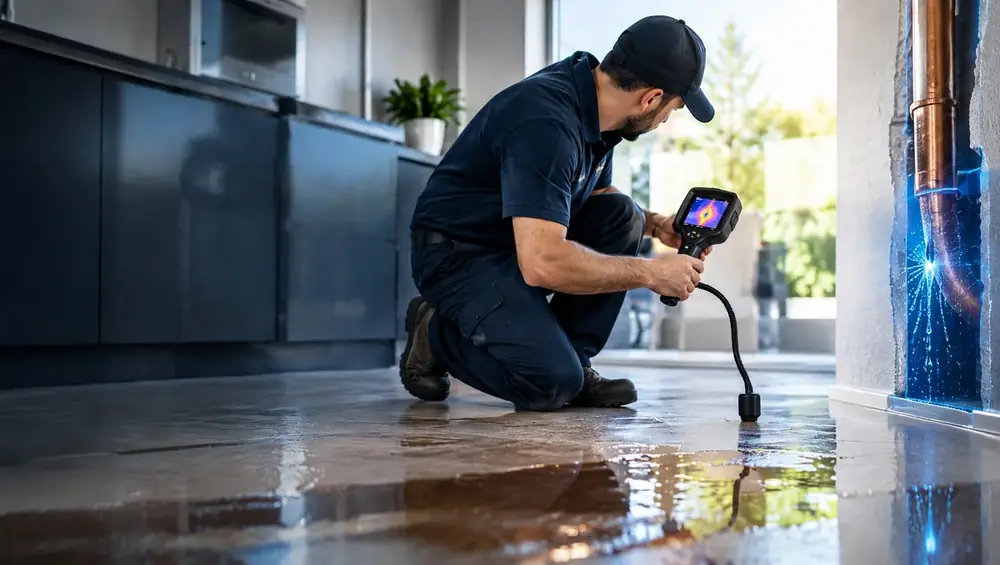
AquaTrace Leak Detection, a leak detection company based in Citrus Heights, serves Citrus Heights and nearby Sacramento County towns. We run a meter test first, then use acoustic listening gear, thermal cameras, and pressure tests to mark the leak spot. You get a plain-words report and a repair plan, with no guesswork and no torn-up floors to start.
How Does a Leak Detection Visit Work?
A leak detection visit follows the same order every time, so nothing gets skipped. Every visit is a full leak inspection, not a single-tool check. You call and describe the signs. We test. We locate. You get findings you can act on.
- You call. Describe the signs: higher bill, wet spot, low pressure, or noise.
- We test. Meter and pressure checks confirm whether water is escaping and in which part of the system.
- We locate. Acoustic leak detection, thermal imaging with an infrared camera, a moisture meter, and sewer camera inspection when drains are involved. The tool fits the symptom.
- You get findings. A marked spot, a plain-words leak detection report, and repair options talked through before anyone cuts anything.
Read more in our guide to how leak detection works or how plumbers find leaks.
Why Hire a Leak Detection Expert Instead of a General Plumber?
A general plumber fixes pipes. A leak detection expert finds leaks. The job differs, so the first step and the tools differ too:
| General plumber | AquaTrace leak detection expert | |
|---|---|---|
| First step | Often opens walls or floors to look for the leak | Meter test and pressure checks first, then listening and thermal tools to mark the spot |
| Tools | General plumbing tools for repair | Acoustic listening, thermal imaging, moisture meter, pressure tests, sewer camera |
| What you get | A repair quote | A plain-words report with the marked spot, to hand to your plumber or insurer |
| Digging | Opens concrete or walls to search | No digging to find the leak; concrete opens only at the marked point if repair needs it |
| Focus | Fixes pipes | Finds leaks. Detection only. |
Leak Detection Services in Citrus Heights
Leak detection in Citrus Heights covers the whole system, inside and out. Hidden leaks behind walls. Underground leaks between the meter and the house. Slab leaks under concrete. Pool leaks and spa leaks. Sewer leaks and main line leaks. Service line leaks at the street connection. Irrigation leaks in yard lines, including backflow preventer leaks. Tree roots in sewer laterals. Summer irrigation leaks that run up a bill with no water showing indoors. One visit, one report, no digging to find it.
- Water Leak Detection
- Slab Leak Detection
- Pool and Spa Leak Detection
- Sewer and Drain Line Leak Detection
- Water Main and Service Line Leak Detection
- Irrigation and Sprinkler Leak Detection
- Commercial Leak Detection
- High Water Bill Leak Investigation
We also handle copper pipe repair, emergency leak repair, and hydro jet sewer cleaning.
Pool leak detection in Citrus Heights starts with a bucket test. Set a bucket on a step, mark both water lines, and wait a day: if the pool drops more than the bucket, water is leaking, not evaporating. Summer heat pushes evaporation up, and the Delta Breeze cools evenings down, so the bucket is the only fair comparison. From there we check the skimmer, return lines, and pool equipment, and test with the pump off. A pool that keeps losing water with the pump off usually leaks in the shell or a fitting, not the equipment pad. See our pool and spa leak detection service and the bucket test guide.
Why Do Citrus Heights Homes Leak?
Citrus Heights homes leak for a few connected reasons: age, soil, water, and pipes:
- 1970s housing stock: median build year around 1977, about 40% built in the 1970s, most on concrete slabs.
- Pipe eras: galvanized steel before the 1980s, copper under slabs, polybutylene from 1978 to 1995 that fails early.
- Fiddyment soil: swells and shrinks with wet winters and dry summers, shifts slabs, stresses joints.
- Hard water: about 11 grains per gallon, scale inside water heaters and lines.
- Climate: summers around 94 degrees in July, rain about 21 to 22 inches from November to March, freeze risk minor, so leaks come from age, soil, and pressure more than frozen pipes.
- Water districts: Citrus Heights Water District and Sacramento Suburban Water District.
We also handle underground water leak detection between the street meter and the house: a wet strip in the yard, sinking soil, or a meter that spins with every fixture off are the signs. See underground leak signs and tests.
How Long Can a Water Leak Go Unnoticed?
Months. A slow slab leak or underground leak may only show up as a water bill that climbs a little each month. A small leak can soak soil, feed mold growth behind drywall, and crack a foundation before anyone sees water. That is why a bill that climbs with no change in use is the sign most homeowners notice first, and why a meter test is worth doing the month the bill jumps, not a year later.
A high water bill is the most common reason people call for leak detection in Citrus Heights.
- A water bill runs by units used, so a leak shows up as units you did not use.
- Compare the bill to the same month last year, not to last month. Summer irrigation and a house guest both move usage.
- A steady climb with no change in habits points to a leak.
- The meter test settles it in two minutes, and our high water bill leak investigation walks the whole system: fixtures, heater, slab lines, and yard lines, to find which part is losing water.
When Do Citrus Heights Leaks Show Up?
Summer
Heat pushes pool evaporation up, so a dropping pool level needs a bucket test to tell evaporation from a leak. Irrigation runs daily, so a yard-line leak or sprinkler leak can run up a bill with no water showing indoors.
Winter Rain (November–March)
About 21 to 22 inches of rain soaks Fiddyment soil, which swells, shifts slabs, and stresses joints. Slab leaks and foundation cracks show up most after wet winters.
Spring Startup
When irrigation starts up again, valve-box and sprinkler-head leaks that sat quiet all winter show up as wet strips and soggy patches.
Year-Round
Hard water at about 11 grains per gallon adds scale inside water heaters and lines, and 1970s pipes keep aging. Pinhole leaks do not wait for a season.
Signs You May Have a Leak
Most leaks announce themselves before they show water. If any of these sound familiar, a meter test will settle it.
Where Are Most Common Water Leaks in a House?
Bathrooms first: toilet flappers, shower valves, and tub spouts. Then kitchens: faucet bases and dishwasher lines, plus water heaters and supply lines under concrete slabs. In Citrus Heights, slab-on-grade homes from the 1970s also see pinhole leaks in copper lines under the floor.
- High water bill with no change in use: often a slab leak, an underground leak, or a running toilet.
- Water meter spinning with every fixture off: water is escaping somewhere in the system.
- Running water sounds at night: a pressurized line leaking under a slab or behind a wall.
- Low water pressure in one area: a supply line leak or a failing shut-off valve.
- Musty smell or mildew odor with no visible water: a hidden leak feeding a wall cavity.
- Wet spots, warped flooring, or a soft floor: water under flooring or under the slab.
- Soggy yard, ponding water, or surface damage in a lawn strip: a buried service line or irrigation leak.
- Sewage odor from drains: a sewer leak or a dry trap, not a supply leak.
- Pool losing water faster than evaporation: a skimmer leak, a return line leak, or a pool equipment leak. Evaporation vs leak is settled with a bucket test.
Sewer leak detection in Citrus Heights starts at the cleanout. Tree roots chase water in older sewer laterals, and a root mass cracks joints and blocks flow. A camera run shows the break on screen, and smoke testing finds cracks that a camera can pass without seeing. A sewer leak smells different from a supply leak: sewage odor from a drain, a soggy strip over the lateral, or a toilet that gurgles when another fixture drains all point to the drain side, not the supply side. See our sewer and drain line leak detection service.
A mystery leak is the one with no puddle, no stain, and no sound, only a bill that climbs or a meter that moves when the house is quiet. These are the leaks that run longest, because nothing looks wrong. The check starts the same way: meter test, then isolation valves to split the system into parts. If the meter stops when the house valve shuts, the leak is inside. If it keeps moving, the leak sits outside, in a service line or yard line.
From there, acoustic gear and thermal imaging take over, and the marked spot ends the mystery. A mystery leak is never a reason to wait. The longer it runs, the more soil it soaks and the more damage it hides.
Slab Leak Detection: Warm Floors, High Bills, and How We Pin It Down
Slab leaks are the most common call from 1970s Citrus Heights homes. Copper lines under concrete wear thin from pipe corrosion, and Fiddyment soil shifts with wet winters and dry summers. A hot spot on floor tiles, a high water bill that keeps climbing, wet spots near a wall, or running water sounds under the floor are the usual signs. A pinhole leak in a copper line can run for months with no puddle at all.
Slab leak detection starts with a meter test and a walk of the floor for warm spots. Then acoustic gear and a thermal camera mark the line, and a pressure test narrows which run is losing water. After that, we lay out spot repair, a pipe reroute through walls, or repiping, and what each means for your floor and your week, so you choose with real facts. Excavation through the slab is the last option, not the first. See our slab leak service, slab leak signs and repair options, and fix a slab leak without breaking the floor.
What You Get on Every Visit
Every visit ends with three things in hand:
- The leak spot, marked.
- A plain-words report of what we found.
- Repair options talked through before anyone cuts anything.
The report is yours to hand to your plumber or insurer. Finding a leak needs no permit. Replacing a concealed pipe can need one, and in California that work falls under a C-36 plumbing contractor. Your plumber handles that part, not the detection visit. No jargon, no guesswork. Read about AquaTrace.
If water is running where it should not be:
- Turn off the house main first, then call.
- If you need leak detection in Citrus Heights in a hurry, describe what is running and where.
- The visit is planned around stopping the water first, then finding the source.
- Property managers and commercial buildings get the same visit at larger scale: one report per building, marked spots per unit or zone, and findings your plumber can work from without reopening walls to re-find the leak. See emergency leak repair and commercial leak detection.
Neighborhoods We Serve in Citrus Heights
Leak detection in Citrus Heights covers all 11 official neighborhoods, from Birdcage Heights to Rusch Park. ZIP codes 95610, 95611, and 95621. From Sunrise Mall and the MarketPlace at Birdcage down Sunrise Boulevard, from Sylvan Corners along Auburn Boulevard to Greenback Lane, and around Rusch Park and Arcade Creek, the housing stock runs the same 1970s slab pattern, so the same leak signs show up across town.
- Birdcage Heights
- Sylvan Old Auburn Road
- Sunrise Ranch
- Stock Ranch
- Northwest Citrus Heights
- Cirby Ranch
- Chase
- Arcade Creek
- Park Oaks
- Sunrise Oaks
- Rusch Park
We also serve Fair Oaks, Orangevale, Carmichael, Antelope, Roseville, and North Highlands, plus Sacramento.
Reviews
AquaTrace is pre-launch, so customer reviews will show here once real jobs are done. See how reviews will work and case studies.
Check for a Leak Yourself in 2 Minutes
Turn off every faucet and fixture, then look at your water meter. If the dial is still moving, water is escaping somewhere. Shut off the main house valve next: if the meter stops, the leak is inside the house. If the meter keeps moving with the house valve shut, the leak sits between the street and the house: an underground or service line leak. This meter behavior check tells you and us where to start. Write down the meter reading before and after the test, so you can tell us exactly what moved. See the full step-by-step in our water meter leak test guide.
Find Your Leak Problem
Start with the symptom:
- Slab leak signs and repair options
- Hidden water leak detection
- Underground water leak detection
- Water heater leaking
- Ceiling and wall leaks
- Toilet leak detection
Learn Before You Call
- How to check your water meter for a leak
- Does insurance cover leak detection?
- How plumbers find hidden leaks
- Can a slab leak be fixed without breaking the floor?
- Why is my water bill so high?
- Pool bucket test: evaporation or leak?
Frequently Asked Questions
How do I know if I have a hidden water leak?
Turn off every fixture and check the meter. If it still moves, water is escaping somewhere. Stains, musty smells, and a rising water bill are other common signs.
What are the most common causes of water leaks in houses?
Aging pipes, pipe corrosion, shifting soil, high water pressure, and worn fixture parts. In Citrus Heights, 1970s copper under slabs and polybutylene lines from 1978 to 1995 fail most often. Tree roots also crack sewer lines, and summer irrigation leaks run up bills without showing water indoors.
How serious is a water leak in a house?
A small leak can do big damage over time. Water soaks framing, feeds mold growth, cracks foundations, and ruins flooring. A slab leak left alone can lift tiles and shift a slab edge. The bill is the least of it. The damage grows while the leak stays hidden, so finding it early costs less in every way.
What happens if you have a water leak under your house?
Water under a slab or in a crawl space soaks soil, shifts the slab, and feeds mold. Floors warm in one spot, tiles crack, and the water bill climbs. Left alone, it can crack a foundation and rot framing. A meter test and acoustic listening find it before the damage spreads.
Will you have to open my walls?
Usually only at the confirmed leak point. We mark the spot first with acoustic listening and thermal imaging, then open only that point for repair. Most of the wall stays untouched, and the repair crew works from the marked spot, not a guess.
Can a slab leak be found without breaking concrete?
Yes. Acoustic and thermal methods usually locate it before any concrete is opened for repair. A pressure test narrows the run, a thermal camera shows the warm line, and acoustic gear pins the spot. Concrete only opens at the marked point, if repair needs it.
How much water loss from a pool is normal?
Evaporation varies with heat, wind, and sun. A bucket test compares the pool to a control bucket: if the pool drops more than the bucket, water is leaking, not evaporating. In Citrus Heights summer heat, some daily loss is normal. Steady loss with the pump off points to a structural or fitting leak.
Does homeowners insurance cover leak detection?
Often the resulting water damage is covered, while the pipe repair itself may not be. Coverage depends on whether the leak was sudden versus gradual, and on your policy. Our insurance guide explains what to document and what to ask your insurer.
Local water providers
If you need to shut off water at the street or report a main-line problem, check with your water provider first: Citrus Heights Water District (CHWD) serves much of Citrus Heights, and Sacramento Suburban Water District (SSWD) serves nearby Sacramento County areas. Your bill shows which district serves your home.
Get a Plan to Find Your Leak
If you need leak detection in Citrus Heights, call AquaTrace, describe what you are seeing, and get a plan to find it.
Call (123) 456-7890Last updated: October 25, 2026.